After ripping out 70 odd ft of Vision1 500T (15 years old) out of a bulk loader and sitting it on my floor in the light (to make room for new Vision2 50D and Vision3 500T for bulk loading... still got another 700 ft of Vision1 500T in cans), I thought of something to do with it.
Cut some of it up, loaded it in a tank, processed it in some Xtol, now then I chilled a weak solution of potassium ferricyanide and potassium bromide to bleach the film back to all silver halide (just silver bromide) slowly to make a high contrast, fine grain, slow speed b&w film.. though I can try putting it through C-41 to get the CMY dyes (wont be a real colour image, but can treat it as a b&w during scanning for chromogenic b&w for IR dust removal), or just regular b&w processing.
The stuff still in the can and old expired film sitting around I have that's now shitty quality (Kodak Gold 100 from 2000), I can try just bleaching the fog (specks of elemental silver) away back to silver halide to restore the speed and denisty range.
If I want to keep it as useful colour film, that will have to be gas bleaching, so that it doesn't wash out the anti-halation layer and the spectral sensitisation dyes etc.
I also figured I could bake some film out in the sun until it is all reduced to metallic silver, and gas-bleach it back to silver halide for a high contrast, fine grain, slow colour film.
Showing posts with label film. Show all posts
Showing posts with label film. Show all posts
Monday, June 6, 2011


Saturday, April 30, 2011
Kodak Australia Helpful
Left a message on the Kodak site U.S. asking the difference between 5219 (Vision3 500T, http://motion.kodak.com/US/en/motion/Products/Production/Color_Negative_Films/5219.htm) and 5230 (500T, http://motion.kodak.com/AU/en/motion/Products/Production/Color_Negative_Films/5230.htm) as it was newly listed with a newer data sheet.
Received a phone call from a Kodak Australia rep (Fuji Australia last year or the year before I had to chase down numbers which most were no longer working it seemed..) explaining that 5230 is basically Vision2 (iirc) and lower cost and aimed for TV dramas etc etc. with a more limited format size and length range. He was quite helpful and enthusiastic
5219 is still the latest and greatest 500T. It comes in 100ft spools.. so it's ready to bulk load, so I dont have to buy a 400ft core and rewind by hand into a bulk loader.. which takes some damn time last time I tried.
50D comes in a 200 ft core at the smallest size.. which isn't too bad, I'd like to try that too.
And also 1000ft of 65mm.. to trim down into my saved up 120 spools and paper.
Received a phone call from a Kodak Australia rep (Fuji Australia last year or the year before I had to chase down numbers which most were no longer working it seemed..) explaining that 5230 is basically Vision2 (iirc) and lower cost and aimed for TV dramas etc etc. with a more limited format size and length range. He was quite helpful and enthusiastic
5219 is still the latest and greatest 500T. It comes in 100ft spools.. so it's ready to bulk load, so I dont have to buy a 400ft core and rewind by hand into a bulk loader.. which takes some damn time last time I tried.
50D comes in a 200 ft core at the smallest size.. which isn't too bad, I'd like to try that too.
And also 1000ft of 65mm.. to trim down into my saved up 120 spools and paper.
Monday, February 28, 2011
New Portra 400... overexposed 5 stops?? ISO 12.5??
Hmmm.
So on one of our photowalks in Melbourne city, I incident metered for the shade, as most of my subject as in the shade and wanted to optimise exposure for my subject, this is an extra +5 stops compared to a subject in the sunlit areas... yet it handled this mixed shade/sun combination beautifully, and flattened out the lighting contrast and did not get too dense, tones are reproduced beautifull for subjects both in shade and sun, it handles such a extreme harsh contrast condition wonderfully.. I have midtones for both!
The New Portra 400.. it has fine grain.. it is very sharp, it has wonderful saturation, and a ton of local contrast snap, very good skin tones.. it is high speed.. it is pushable.. it handles overexposure, it retains highlights, it can compensate high contrast with increased exposure without pull-processing.. if you had to have only 1 colour film, this would be it, forget Ektar, you can do everything with this.
If I was shooting for the sunlit area.. you would call this an EI of 12.5! This isn't a pull-process either, it is standard.

First 10 people in Australia to Like my services page, get free C-41 processing and web size scanning of a single roll of 35mm or 120, includes cross-processing and an pull/push you wish to have done.
http://www.photodan.com.au/services.php
So on one of our photowalks in Melbourne city, I incident metered for the shade, as most of my subject as in the shade and wanted to optimise exposure for my subject, this is an extra +5 stops compared to a subject in the sunlit areas... yet it handled this mixed shade/sun combination beautifully, and flattened out the lighting contrast and did not get too dense, tones are reproduced beautifull for subjects both in shade and sun, it handles such a extreme harsh contrast condition wonderfully.. I have midtones for both!
The New Portra 400.. it has fine grain.. it is very sharp, it has wonderful saturation, and a ton of local contrast snap, very good skin tones.. it is high speed.. it is pushable.. it handles overexposure, it retains highlights, it can compensate high contrast with increased exposure without pull-processing.. if you had to have only 1 colour film, this would be it, forget Ektar, you can do everything with this.
If I was shooting for the sunlit area.. you would call this an EI of 12.5! This isn't a pull-process either, it is standard.

First 10 people in Australia to Like my services page, get free C-41 processing and web size scanning of a single roll of 35mm or 120, includes cross-processing and an pull/push you wish to have done.
http://www.photodan.com.au/services.php
Portra 400 pushed to 25600
Pushed 6 stops. 7 minutes and 30 seconds processing time in Flexicolor C-41 at 39 degrees celsius.
Density range is thin, image is poor, and lots of scanner noise present. It's at this point several things spring to mind:
1. Use a fast lens to begin with (well I just need the $ for that Mamiya 645 80mm f/1.9!)
2. It's at this point, the mercury vapour and hydrogen peroxide latensification looks attractive.
3. Perhaps a tiny pre-flash.
4. A "pre-developer" if you will for about 1 minute or so, phenidone-ascorbic acid speed enhancing developer, long enough to begin to have action, without making a visible image, just to amplify the silver image a bit, in case C-41 can't discern as low intensity sites as a speed enhancing b&w dev can. Which then can be then processed through C-41 after.
5. Rehal processing, after bleaching, instead of fixing, run it through C-41 again to increase dye gain.
6. Combine hydrogen peroxide with a colour developer or C-41 during development to gain more dye yield.
7. Combine points 2 through 6.
Anyway, here is one of the images, probably the best off the roll. I do not recommend this. A push to 6400 might be doable to a good quality, the 3200 results I've seen online are quite good, I think a push to 6400, but shot with an EI of 3200 might be best though.
First 10 peoplein Australia to click Like on my services page get free C-41 processing and web size scanning for any 35mm or 120, including cross-processing and/or push/pulling (still need to get your film to me and provide return postage if you're not local).
http://www.photodan.com.au/services.php

Sunday, October 10, 2010
Things to try
Been in Melb for 6 weeks now...
Got a few things to try... pull-processing C-41 film, which I've already done in Rodinal and re-developed to colour before.. though that was 14 stop pull... good for daytime long exposure with no filters.
Got some old ISO 400 film that seems a bit crap and foggy at 400... though I did accidentally overdevelop it. Anyway, expose it at EI 50 and develop for 2 min 45 sec is the plan to see how it comes out.
Some bigger pulls with shorter times or C-41 with a 1+1 or 1+2 dilution and EI 12 and slower just to have a play.
Need to find some HCl from a pool shop to finish my concentrated 2 part colour negative developer.
Also got a roll of Rollei Pan 25 to test out.. not sure what to actually use it on though is the problem.
I want to try some Ektar 100 in 35mm lab-developed, and developed 'normally' (EI 100) in my concentrated developer (1+1+50), and pulled to EI 25 (1+1+100), with 8000 dpi Flextight 848 scans - just to ascertain differences.
The unbranded 400 ISO C-41 film shot @ EI 400, developed 3 min 45 sec accidentally and not agitated much (2 stop accidental push, was very dense and crappy), developed in Kodak Flexicolor at home, colour corrected (since it's C-41, posting orange negatives would be kinda odd).


Got a few things to try... pull-processing C-41 film, which I've already done in Rodinal and re-developed to colour before.. though that was 14 stop pull... good for daytime long exposure with no filters.
Got some old ISO 400 film that seems a bit crap and foggy at 400... though I did accidentally overdevelop it. Anyway, expose it at EI 50 and develop for 2 min 45 sec is the plan to see how it comes out.
Some bigger pulls with shorter times or C-41 with a 1+1 or 1+2 dilution and EI 12 and slower just to have a play.
Need to find some HCl from a pool shop to finish my concentrated 2 part colour negative developer.
Also got a roll of Rollei Pan 25 to test out.. not sure what to actually use it on though is the problem.
I want to try some Ektar 100 in 35mm lab-developed, and developed 'normally' (EI 100) in my concentrated developer (1+1+50), and pulled to EI 25 (1+1+100), with 8000 dpi Flextight 848 scans - just to ascertain differences.
The unbranded 400 ISO C-41 film shot @ EI 400, developed 3 min 45 sec accidentally and not agitated much (2 stop accidental push, was very dense and crappy), developed in Kodak Flexicolor at home, colour corrected (since it's C-41, posting orange negatives would be kinda odd).


Thursday, September 16, 2010
New Portra 400 film

New Portra 400 announced - http://www.kodak.com/global/en/professional/products/films/portra/400main.jhtml
Images - http://canlasphotography.blogspot.com/2010/08/film-is-not-dead-san-diego-v-20-day-3.html
http://www.facebook.com/album.php?aid=213771&id=87452556121
Replaces both 400NC and 400VC, it has the contrast of NC, it uses improvements from the Vision ECN-2 motion picture film line with saturation between NC and VC, finer grain and greater resolution (sharper) apparently. It wil lbe avaiable in 35mm 36exp, 120 roll, 220 roll and 4x5 sheet film (no 8x10).
400NC and 400VC are expected to be available until December 2010.
Given it's finer and sharper characteristics and low contrast, I look forward to treating it like Tri-X (yes yes, completely different film, but still..), I would like to try Rodinal 1+100, 2 hour semi-stand first dev (EI 6400 for Tri-X), and colour rehal dev, and also a custom colour developer for pushing, just to see.
My thoughts is that this is a 400NC replacement with improvements, 400VC also appears more vivid than 400NC because of its greater contrast, the new 400 retains 400NC's contrast with greater saturation, but shouldn't appear so vivid.
If you cant do without 400VC, buy up, and an extra freezer to stick it in.

Friday, July 30, 2010
Mamiya RB67 ProS Repair Manual and Parts Catalog
A kind internet user has emailed me both the parts catalog and repair manual/sevice instructions for the Mamiya RB67 ProS, I previously scoured the internet for these but could not find either.
So I am making them available here for all film users, enjoy.
Service Instructions for Mamiya RB67 ProS
https://docs.google.com/fileview?id=12CM_sA3yELlU4ek6n7e5QCF7yAZjnOOo4zicWgWWc0ewuMDfm-9P8zGGmjPV&hl=en&authkey=CIH7t-0M
Parts Catalog for Mamiya RB67 ProS
https://docs.google.com/fileview?id=1zH6tCMpny0AnZvulZzEkjiy1eHmDWBve0K70pH7CFWjvoLpem_sYmOaRTDw0&hl=en&authkey=CLaQ9eoC
So I am making them available here for all film users, enjoy.
Service Instructions for Mamiya RB67 ProS
https://docs.google.com/fileview?id=12CM_sA3yELlU4ek6n7e5QCF7yAZjnOOo4zicWgWWc0ewuMDfm-9P8zGGmjPV&hl=en&authkey=CIH7t-0M
Parts Catalog for Mamiya RB67 ProS
https://docs.google.com/fileview?id=1zH6tCMpny0AnZvulZzEkjiy1eHmDWBve0K70pH7CFWjvoLpem_sYmOaRTDw0&hl=en&authkey=CLaQ9eoC
Sunday, June 13, 2010
16mm Motion Picture Film Developing Tank Mk1 aka "Missile Launcher"
Okay so the first developing tank is completed, it has numerous problems in operation, though isnt expensive to make, is a pain in the arse to actually use, I have already learned a lot and have a number of refinements for the heliacal-spiral type, though I'm 'putting my money' on a simple 2D spiral type.
Ultimately I want to construct something that has semi-automatic loading of up to 1000 ft in lengths in both 16mm and 35mm formats, which I have a few ideas for the future for.
Anyway, I've posted a video on vimeo detailing on putting this first version together, I will post chemistry mixing for ECN-2 and other videos in the future, such as other tank versions, and actually processing ECN-2 film, and B&W motion picture reversal stock.
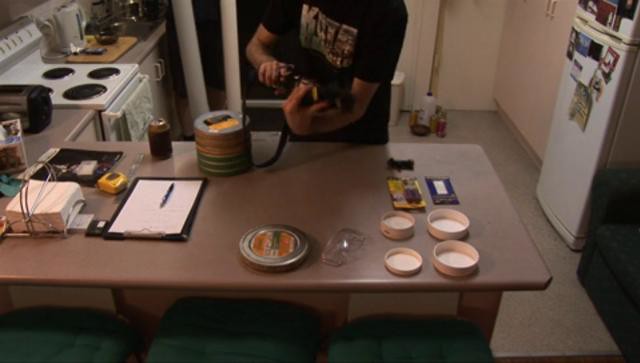
http://vimeo.com/12522602
Video journal of the "missile launcher" (since it likes to launch the inner tube like a missile if you dont tape the end cap on when using it).
This shows construction of the first 16mm ~100ft I built (ended up being 86.5ft in this one).
There are problems with this design I didn't know about or think of until I went to use it.
This design takes a long time to construct, is very difficult to load.
I would also recommend if using the heliacal-spiral type like this desig of mine, to have the spiral track cut into a tube (perhaps a wooden solid cylinder?) about 0.5cm+ deep so the film can be crank-wound on.
Currently, at the moment I recommend a 2D spiral type on a base board that gets placed into a bath, a spiral may seem hard to make, but you can do it with vertical rods (nails, dowel, otherwise, etc) rather than two tracks at bottom and top like a 35mm/120 roll hand processing tank for still film.
If your film needs to touch against something (such as the rod 2D spiral type or rack processor, or this tank in the video) wind it on so the emulsion side is not touching anything, then it is perfectly fine.
I'll make a new tank and show a video, as well as mixing up useable formula for processing ECN-2 at some point.
I'll be scaling up my final design when I find the perfect design after building enough 100ft tanks for 400ft and 1000ft and 35mm as well.
Friday, May 7, 2010
Canon CanoScan 9000F Film Scanner
Attention Canon: Lies and re-iterated useless crap we film users are all god damn sick of makes me fucking angry.
So Canon have released a new film scanner.
http://www.usa.canon.com/consumer/controller?act=ModelInfoAct&fcategoryid=120&modelid=20411
It accomodates 35mm and 120, but not sheet sizes, unfortunately it is yet another fucking flatbed.
Apparently it's "been designed with film-faithful photographers in mind" - Jesus Tittyfucking Christ, you think these idiots would have learned by now we are god damn sick of their incompetent flatbed rubbish, no it has not been designed with film-faithful photographers in mind, it has been designed by marketing with dollar signs in mind, it is clear they are fucking incapable (read: unwilling) to improve 3 critical things in flatbeds since 2 decades ago:
1. Signal to Noise ratio, the sensors have nasty nasty noise, and typically scan at slightly different exposure times per line, which you can see when you need to stretch levels due to the scanner's shithouse dMax that's actually half of the advertised value.
2. DMax, has such poor DMax values, and the entire range isnt useable, the shadow and highlights section of the scanner are both so poor in quality, as to render an unusable image if your film falls on either end of it and not in the middle of the range.
3. True Resolution, these idiots want to up the sensor resolution, but they will not put in even $20 worth of optics to even be able to resolve anywhere near 50% of the claimed optical resolution.
Canon, Epson and others are LIARS and are committing FRAUD, they state a number like 4800 or 6400 dpi for optical resolution, when the optics they put in the scanners do not have that resolution, they are taking the sensor resolution and calling it optical resolution, that is plain fucking lying, it is also fraudulently misrepresenting the true performance of the scanner.
In the 9000F's case, it is 9600 dpi, fat chance they are putting in optics capable of resolving that sensor resolution, if Canon even put in optics that could resolve even a third of that (3200 dpi) I'd be over the moon and buy one to replace my piece of shit V500 for scanning 120 straight away soon as it was available.
Canon once made a great 4000 dpi scanner called the FS4000US, but what happened? It was discontinued with flatbeds as the replacement! Fuck me!
It's not impossible to make a flatbed form factor/design scanner with a high dMax, good SNR and with sharp optics, it is just not done for some reason, and I would love it if Canon have put that kind of equipment in their 9000F, it would make me happy to have available a good scanner on the market than can scan 120.
Currently, there is no such thing as a good 120 scanner available, they're all fucking shit, you have to find the ridiculously high priced 2nd hand dedicated scanners.
9600 dpi is just another fucking figure gimmick to complete with Epsons "6400" dpi, and probably to try and steal some market away from Plustek's 7200 dpi scanners given the indicated price point is just under the plusteks.
These scumbag marketing tactics while providing an inferior product are disgusting.
If you want a good 35mm scanner, the Plustek 7400 and 7600i are the choices available apart from 2nd hand dedicated scanners.
Even without the optics to support the resolution, if the 9000F had sheet film scanning, with a decent sensor (ACTUAL USEABLE capable dMax rating), with a good SNR, and non-varying exposure between each set of lines, then it'd be an awesome buy.
So Canon have released a new film scanner.
http://www.usa.canon.com/consumer/controller?act=ModelInfoAct&fcategoryid=120&modelid=20411
It accomodates 35mm and 120, but not sheet sizes, unfortunately it is yet another fucking flatbed.
Apparently it's "been designed with film-faithful photographers in mind" - Jesus Tittyfucking Christ, you think these idiots would have learned by now we are god damn sick of their incompetent flatbed rubbish, no it has not been designed with film-faithful photographers in mind, it has been designed by marketing with dollar signs in mind, it is clear they are fucking incapable (read: unwilling) to improve 3 critical things in flatbeds since 2 decades ago:
1. Signal to Noise ratio, the sensors have nasty nasty noise, and typically scan at slightly different exposure times per line, which you can see when you need to stretch levels due to the scanner's shithouse dMax that's actually half of the advertised value.
2. DMax, has such poor DMax values, and the entire range isnt useable, the shadow and highlights section of the scanner are both so poor in quality, as to render an unusable image if your film falls on either end of it and not in the middle of the range.
3. True Resolution, these idiots want to up the sensor resolution, but they will not put in even $20 worth of optics to even be able to resolve anywhere near 50% of the claimed optical resolution.
Canon, Epson and others are LIARS and are committing FRAUD, they state a number like 4800 or 6400 dpi for optical resolution, when the optics they put in the scanners do not have that resolution, they are taking the sensor resolution and calling it optical resolution, that is plain fucking lying, it is also fraudulently misrepresenting the true performance of the scanner.
In the 9000F's case, it is 9600 dpi, fat chance they are putting in optics capable of resolving that sensor resolution, if Canon even put in optics that could resolve even a third of that (3200 dpi) I'd be over the moon and buy one to replace my piece of shit V500 for scanning 120 straight away soon as it was available.
Canon once made a great 4000 dpi scanner called the FS4000US, but what happened? It was discontinued with flatbeds as the replacement! Fuck me!
It's not impossible to make a flatbed form factor/design scanner with a high dMax, good SNR and with sharp optics, it is just not done for some reason, and I would love it if Canon have put that kind of equipment in their 9000F, it would make me happy to have available a good scanner on the market than can scan 120.
Currently, there is no such thing as a good 120 scanner available, they're all fucking shit, you have to find the ridiculously high priced 2nd hand dedicated scanners.
9600 dpi is just another fucking figure gimmick to complete with Epsons "6400" dpi, and probably to try and steal some market away from Plustek's 7200 dpi scanners given the indicated price point is just under the plusteks.
These scumbag marketing tactics while providing an inferior product are disgusting.
If you want a good 35mm scanner, the Plustek 7400 and 7600i are the choices available apart from 2nd hand dedicated scanners.
Even without the optics to support the resolution, if the 9000F had sheet film scanning, with a decent sensor (ACTUAL USEABLE capable dMax rating), with a good SNR, and non-varying exposure between each set of lines, then it'd be an awesome buy.
Thursday, April 29, 2010
Gold Coast Super 16mm HD Telecine Experience
Fuck me, this is going to be a rant, and a warning (hopefully) to others about using The Post Lounge (http://www.thepostlounge.com/) for telecine transfers (example at the end)
Just got out S16mm HD telecine back that we got done at The Post Lounge at the warner studio lot and I am angry.
Originally it was $450 for our HD telecine for the hour, uncompressed 10-bit onto a drive we supplied, and get it back same day.
Anyway, they notified us like 2 days before they were increasing the cost to $1000 iirc (and we ended up only in there for 20 minutes), which included postage (postage was like $250) to their Brisbane office so they could capture the tape.
They also notified us that they were scheduling us an hour earlier (hold - we're paying for it and booked our time - and now we're paying over double for it, for a worse end result, and we have to do it to their terms when they know how far we have to drive up to supervise?)
We didn't have have a choice to send it anywhere else after that, since it was already up there for processing and then delivered to the place for our arrival to supervise the telecine (nice and sharp on the raw telecine, soft as a soggy kleenex once we got the footage back). We were also asked "where's your film?", they had to go chase it up after we reminded them that it was delivered to them directly from the lab (which is the usual case), that's not really even an annoyance or concern for me though.
Anyway after the telecine operator went through it, he put it out to tape, which ended up being HDCAM, not HDCAM SR, but HDCAM 3:1:1 8-bit 1440x1080
Which sucks, what I'd like to point out at this point, is when we got the footage back, I noticed that the gamma and white points the operator had set, suit when the camera is spinning up or spinning down (which exposes the negative more and hence increases overall density) and not when the camera was at speed (in our case, 25 fps), so the white point has been set for the brightest highlights 2+ stops above our useful footage.
A fucking monkey pressing an auto-levels button could do that, why the fuck would you pick the sections where you turn on and off the camera (which have the greatest highlight density) to set the white point to?!
Now if we were getting the uncompressed footage, this wouldn't be a problem, may even be not so bad with HDCAM SR, but that simple fact means we have vastly less information/bit distribution etc for our useful footage, he may as well have just run an auto-levels over the entire lot of the footage in one go and set black to minimum neg density, and white to maximum neg density.
Oh, and the footage went through a second stage of lossy compression during capturing at the Brisbane location, which just makes it worse.
What it means, is twice the cost, for an inferior service and end product (soft, noisy, simple grading after levels correction causes banding), and a wait of a week, instead of same day.
So, apparently, they no longer have the facilities to do a transfer at their Gold Coast presence (and the packaging they put the drive in must be made out of gold foil to justify the $250 postage price for the drive).
So I would just like to put that out there in case there happens to be even one of you out there on a production considering getting a telecine done on the Gold Coast - I'd say to you, consider if that suits your needs, and if it does, I'd say it'd be cheaper and less time consuming to shoot on HDV. If it doesn't - look elsewhere, courier to Sydney etc (will cost a lot less too).
Verdict: Shameful service, just because we're only getting 400 ft of film done doesn't mean they can neglect our service, put a lovely tax on us (over twice the cost in total including $250 for postage over a distance of 100km?!), do a fucking shameful job, and after charging us over double compress out footage down using a codec with a shitty bit-depth and nasty chroma-subsampling with an anamorphic aspect ratio (throwing out resolution) that is 13 years old to tape only to be captured and lossy compressed again.
Do you even give a fuck about your business, or the job you do and quality of service you provide?
Here is one example of a typical well-exposed scene at EI50 (Even if it was underexposed, which it wasn't, a normal telecine operator would sit correct it and set the white point, gamma and black points), and the version after that I simply set black and white points on, not even touching gamma, gosh that was such hard work!
Simply click on the examples for the full-resolution ("1920" x 1080) image.


Just got out S16mm HD telecine back that we got done at The Post Lounge at the warner studio lot and I am angry.
Originally it was $450 for our HD telecine for the hour, uncompressed 10-bit onto a drive we supplied, and get it back same day.
Anyway, they notified us like 2 days before they were increasing the cost to $1000 iirc (and we ended up only in there for 20 minutes), which included postage (postage was like $250) to their Brisbane office so they could capture the tape.
They also notified us that they were scheduling us an hour earlier (hold - we're paying for it and booked our time - and now we're paying over double for it, for a worse end result, and we have to do it to their terms when they know how far we have to drive up to supervise?)
We didn't have have a choice to send it anywhere else after that, since it was already up there for processing and then delivered to the place for our arrival to supervise the telecine (nice and sharp on the raw telecine, soft as a soggy kleenex once we got the footage back). We were also asked "where's your film?", they had to go chase it up after we reminded them that it was delivered to them directly from the lab (which is the usual case), that's not really even an annoyance or concern for me though.
Anyway after the telecine operator went through it, he put it out to tape, which ended up being HDCAM, not HDCAM SR, but HDCAM 3:1:1 8-bit 1440x1080
Which sucks, what I'd like to point out at this point, is when we got the footage back, I noticed that the gamma and white points the operator had set, suit when the camera is spinning up or spinning down (which exposes the negative more and hence increases overall density) and not when the camera was at speed (in our case, 25 fps), so the white point has been set for the brightest highlights 2+ stops above our useful footage.
A fucking monkey pressing an auto-levels button could do that, why the fuck would you pick the sections where you turn on and off the camera (which have the greatest highlight density) to set the white point to?!
Now if we were getting the uncompressed footage, this wouldn't be a problem, may even be not so bad with HDCAM SR, but that simple fact means we have vastly less information/bit distribution etc for our useful footage, he may as well have just run an auto-levels over the entire lot of the footage in one go and set black to minimum neg density, and white to maximum neg density.
Oh, and the footage went through a second stage of lossy compression during capturing at the Brisbane location, which just makes it worse.
What it means, is twice the cost, for an inferior service and end product (soft, noisy, simple grading after levels correction causes banding), and a wait of a week, instead of same day.
So, apparently, they no longer have the facilities to do a transfer at their Gold Coast presence (and the packaging they put the drive in must be made out of gold foil to justify the $250 postage price for the drive).
So I would just like to put that out there in case there happens to be even one of you out there on a production considering getting a telecine done on the Gold Coast - I'd say to you, consider if that suits your needs, and if it does, I'd say it'd be cheaper and less time consuming to shoot on HDV. If it doesn't - look elsewhere, courier to Sydney etc (will cost a lot less too).
Verdict: Shameful service, just because we're only getting 400 ft of film done doesn't mean they can neglect our service, put a lovely tax on us (over twice the cost in total including $250 for postage over a distance of 100km?!), do a fucking shameful job, and after charging us over double compress out footage down using a codec with a shitty bit-depth and nasty chroma-subsampling with an anamorphic aspect ratio (throwing out resolution) that is 13 years old to tape only to be captured and lossy compressed again.
Do you even give a fuck about your business, or the job you do and quality of service you provide?
Here is one example of a typical well-exposed scene at EI50 (Even if it was underexposed, which it wasn't, a normal telecine operator would sit correct it and set the white point, gamma and black points), and the version after that I simply set black and white points on, not even touching gamma, gosh that was such hard work!
Simply click on the examples for the full-resolution ("1920" x 1080) image.


Tuesday, April 20, 2010
Colour Photographic Formulae and Processing Times
I didn't write the following documents, these documents were collated and created and sent to me by APUG user mts, but I will try to update them and add notes when I experiment with any of them, I hope they serve someone well when this kind of information is hard to come by and seems to be disappearing, I hope to preserve and grow this information for the benefit of all film users world wide.
If you have any questions or queries, leave a comment, or join APUG.
Formula:
http://docs.google.com/View?id=dhb94mck_38crprhxcf
Processing:
http://docs.google.com/View?id=dhb94mck_32vc6d7h68
If you have any questions or queries, leave a comment, or join APUG.
Formula:
http://docs.google.com/View?id=dhb94mck_38crprhxcf
Processing:
http://docs.google.com/View?id=dhb94mck_32vc6d7h68
Subscribe to:
Comments (Atom)